


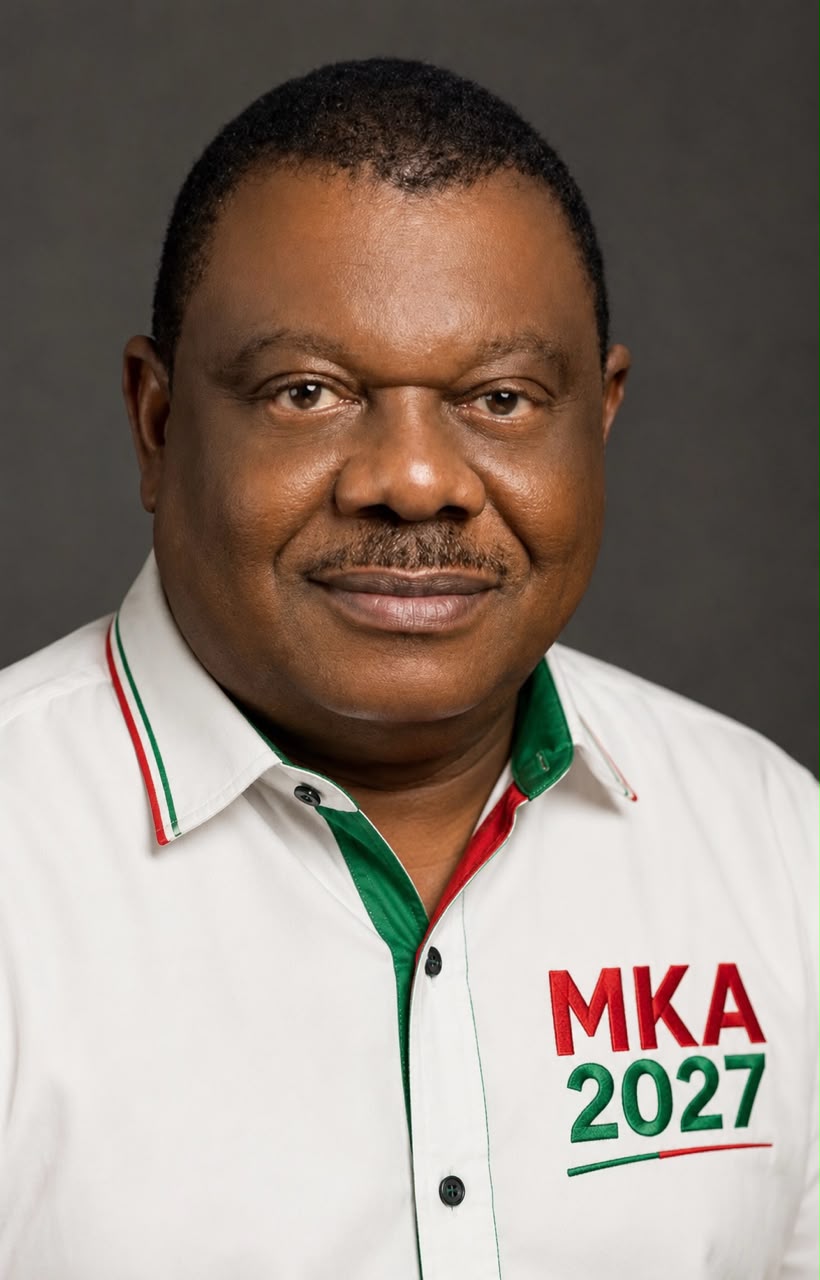
The argument that the Supreme Court has permanently barred Chief Michael Kaase Aondoakaa, SAN, from contesting the 2027 Benue State governorship election is, with respect, unsupported by the Constitution of the Federal Republic of Nigeria, 1999 (as amended), or by established principles of Nigerian constitutional and electoral law.
A careful examination of the Constitution and relevant judicial authorities shows that the legal basis for such a claim does not exist.
The Constitution Is Supreme
The starting point is the Constitution itself.
Section 1(1) declares the Constitution to be the supreme law of the land, binding on all authorities and persons throughout Nigeria. Section 1(3) further provides that where any other law is inconsistent with the Constitution, the Constitution prevails, and the inconsistent law becomes void to the extent of its inconsistency.
This means that any question concerning eligibility to contest the office of Governor must be determined strictly by the Constitution.
What the Constitution Says About Eligibility
The qualifications for election as Governor are comprehensively set out in Section 177 of the Constitution, while the grounds for disqualification are expressly contained in Section 182.
These constitutional provisions form a complete code on who may or may not contest for the office of Governor.
Notably, they do not list a prior civil judgment restraining a person from holding public office as a constitutional ground for disqualification from an elective office.
Appointment and Election Are Not the Same
The Constitution clearly distinguishes between appointment into public office and election into public office.
Elective offices derive their legitimacy directly from the will of the electorate through the ballot. Their qualifications and disqualifications are governed by Sections 65, 66, 106, 107, 131, 137, 177 and 182 of the Constitution, while elections are conducted under Sections 76, 116, 132 and 178.
The Campaign Of Falsehood Against Chief Aondoakaa Has Collapsed, the Law Has Since Spoken
Appointed public offices, however, derive their legitimacy from constitutional or statutory appointing authorities. These appointments are governed by separate constitutional provisions, including Sections 147, 171, 192, 197, 208 and 271–296, depending on the office concerned.
The Supreme Court recognised this distinction in A.G. Federation v. Abubakar (2007) 10 NWLR (Pt. 1041) 1, where it held that constitutional offices derive their existence, powers and tenure strictly from the Constitution.
Similarly, in PDP v. INEC (1999) 11 NWLR (Pt. 626) 200, the Court reiterated that elective offices arise from the constitutional electoral process and are fundamentally different from offices filled through executive appointment.
Group Challenges Alia to Explain Benue’s Poor Ranking in 2026 Phillips Consulting Index
The Court of Appeal, affirmed by the Supreme Court in INEC v. Musa (2003) 3 NWLR (Pt. 806) 72, also held that the right to contest an election is a constitutional and political right governed by the Constitution and electoral laws—not by rules applicable to appointments into the public service.
Constitutional Disqualifications Cannot Be Expanded
Because the Constitution expressly states the qualifications and disqualifications for elective offices, courts cannot introduce additional conditions by implication.
This principle was affirmed in A.G. Bendel State v. A.G. Federation (1981) 10 SC 1, where the Supreme Court held that courts are not permitted to read into the Constitution provisions that are not expressly stated.
Therefore, while every elective office is a public office, not every rule relating to appointments into public office applies to elections.
The Constitution creates separate pathways for appointment and election, each with distinct qualifications, procedures and legal consequences.
The Supreme Court Has Consistently Maintained This Position
The Supreme Court has repeatedly held that constitutional qualifications and disqualifications must be interpreted strictly.
In PDP v. INEC (1999) 11 NWLR (Pt. 626) 200, the Court emphasised that constitutional qualifications cannot be enlarged by implication.
Likewise, in Marwa v. Nyako (2012) 6 NWLR (Pt. 1296) 199, the Court reaffirmed that constitutional provisions relating to tenure and eligibility must be interpreted according to their express language.
Accordingly, unless Chief Michael Kaase Aondoakaa, SAN, falls within any of the disqualifying circumstances expressly listed in Section 182 of the Constitution, he remains constitutionally qualified to contest.
Understanding the Supreme Court Judgment in Aondoakaa v. Obot
It is true that in Aondoakaa v. Obot & Anor. (SC.939/2015), the Supreme Court affirmed the concurrent judgments of the lower courts.
However, it is a settled principle that every judgment must be read as a whole.
The Supreme Court itself cautioned in A.G. Federation v. A.G. Abia State (No. 2) (2002) 6 NWLR (Pt. 764) 542 that a judgment must be interpreted in its entirety to ascertain its true ratio decidendi.
The Statement Relied Upon Must Be Read in Context
Much attention has been given to the observation by Justice Kudirat Kekere-Ekun that Chief Aondoakaa “ought not to be entrusted with any other public office at all.”
Respectfully, that statement must be understood within its proper legal context.
A lead judgment forms part of the Court’s decision but cannot extend the ratio decidendi beyond the issues submitted for determination. It cannot create a new constitutional ground of disqualification where the Constitution provides none.
Significantly, Justice Mary Peter-Odili expressly observed that the issue of Chief Aondoakaa’s qualification to hold future public office did not arise for determination in that appeal.
That observation reinforces the long-established principle that courts decide only issues properly placed before them.
As the Supreme Court held in A.G. Lagos State v. A.G. Federation (2014) 9 NWLR (Pt. 1412) 217, courts do not pronounce on hypothetical or academic questions.
No Lifetime Ban Exists
Equally important, the Supreme Court’s judgment contains no express declaration that Chief Aondoakaa is disqualified for life from contesting elective office.
Such language does not appear in the operative orders of the Court.
It would therefore be legally unsafe to infer a lifetime constitutional disability from observations that were not translated into an enforceable constitutional order.
The Right to Contest Is a Constitutional Right
The right to seek elective office is a constitutional and democratic right.
Although that right is subject to constitutional limitations, those limitations must be expressly stated in the Constitution.
In Rabiu v. State (1980) 8–11 SC 130, the Supreme Court held that constitutional provisions should receive a broad and liberal interpretation that promotes, rather than unnecessarily restricts, constitutional rights.
Conclusion
Under Nigeria’s constitutional democracy, eligibility for elective office is determined primarily by the Constitution.
Unless a candidate falls within one or more of the disqualifying provisions of Section 182—or there is a subsequent binding judicial pronouncement specifically interpreting Sections 182 and 285(14)(a) of the Constitution as creating a constitutional bar arising from the earlier non-electoral civil case—the contention that Chief Michael Kaase Aondoakaa, SAN, is constitutionally disqualified from contesting the 2027 Benue State governorship election remains legally misconceived.
Chief Aondoakaa is therefore entitled to present himself for nomination and election as Governor of Benue State.
In constitutional adjudication, courts do not legislate by implication. They apply the Constitution as written. Since the Constitution does not expressly disqualify Chief Michael Kaase Aondoakaa, SAN, on the basis of the earlier Supreme Court judgment, the legal presumption remains that his constitutional right to contest elections is intact.
Author:
Alex Ter Adum, PhD
Former Attorney-General and Commissioner for Justice, Benue State